How to Get Grass Stains Out of Carpet
Key takeaways
- Grass stains are a three-component stain: chlorophyll, tannins, and protein. Each bond to carpet fiber differently and requires OXY chemistry to fully break down.
- Vacuuming before wet cleaning is essential for grass stains. Loose grass blades and soil must come out before any moisture is introduced or they become embedded residue.
- Heat sets grass stains – avoid hot water at every stage of cleaning.
- Dried grass stains require loosening before pre-treating, but respond to the same OXY cleaning process as fresh grass stains, though they may need extra dwell time and passes.
Jump to cleaning instructions
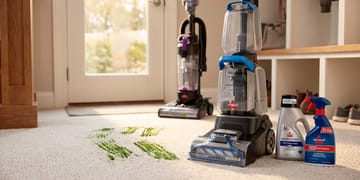
Kids track it in from the backyard. Pets run through it and bring it straight to the living room. With yards all around, grass stains on carpet are one of the most common household stains – and one of the more stubborn. That vivid green pigment – thanks to chlorophyll – resists most household remedies and gets harder to remove the longer it sits.
This guide, assembled by the cleaning experts at BISSELL, covers how to fully remove grass stains from carpet using the right tools, the right pre-treat chemistry, and a purpose-built upright carpet cleaner.
Pro tip: Chlorophyll bonds to carpet fiber the way it bonds to fabric — fast and aggressively. The single most important thing you can do before any wet treatment is vacuum up every loose blade and soil particle first. Moisture turns dry debris into embedded residue, making the stain harder to remove, not easier.
Why grass stains are stubborn
Chlorophyll, tannins, and protein – a three-component stain
Grass stains are chemically more complex than they appear. The green color comes from chlorophyll – a large organic pigment molecule that bonds readily to both natural and synthetic carpet fibers. Alongside chlorophyll, grass contains tannins (the same plant-based compounds found in coffee, tea, and tomato) that bond aggressively to fiber, and proteins that set when exposed to heat. Each component requires specific chemistry to break down – which is why surface treatments that address one part of the stain while missing the others leave a residual mark even after cleaning.
Why grass stains get worse when they dry
A fresh, wet grass stain that hasn't been ground in to a carpet is significantly easier to remove than one that has had time to dry. As moisture evaporates, chlorophyll and tannin pigments bond more firmly to the fiber. Grass that has been tracked across a room and ground underfoot has been mechanically pressed into the pile, distributing the stain across a wider area and driving it deeper into the fiber base.
Act as quickly as possible – but know that dried grass stains are still treatable with the right chemistry and cleaning tools.
Why heat sets grass stains
Heat accelerates the bonding of chlorophyll and protein to carpet fiber. The TurboClean™ Pet Upright Carpet Cleaner uses warm water extraction, which is the correct approach: enough warmth to loosen the stain without the heat or excess moisture that causes damage.
What you'll need
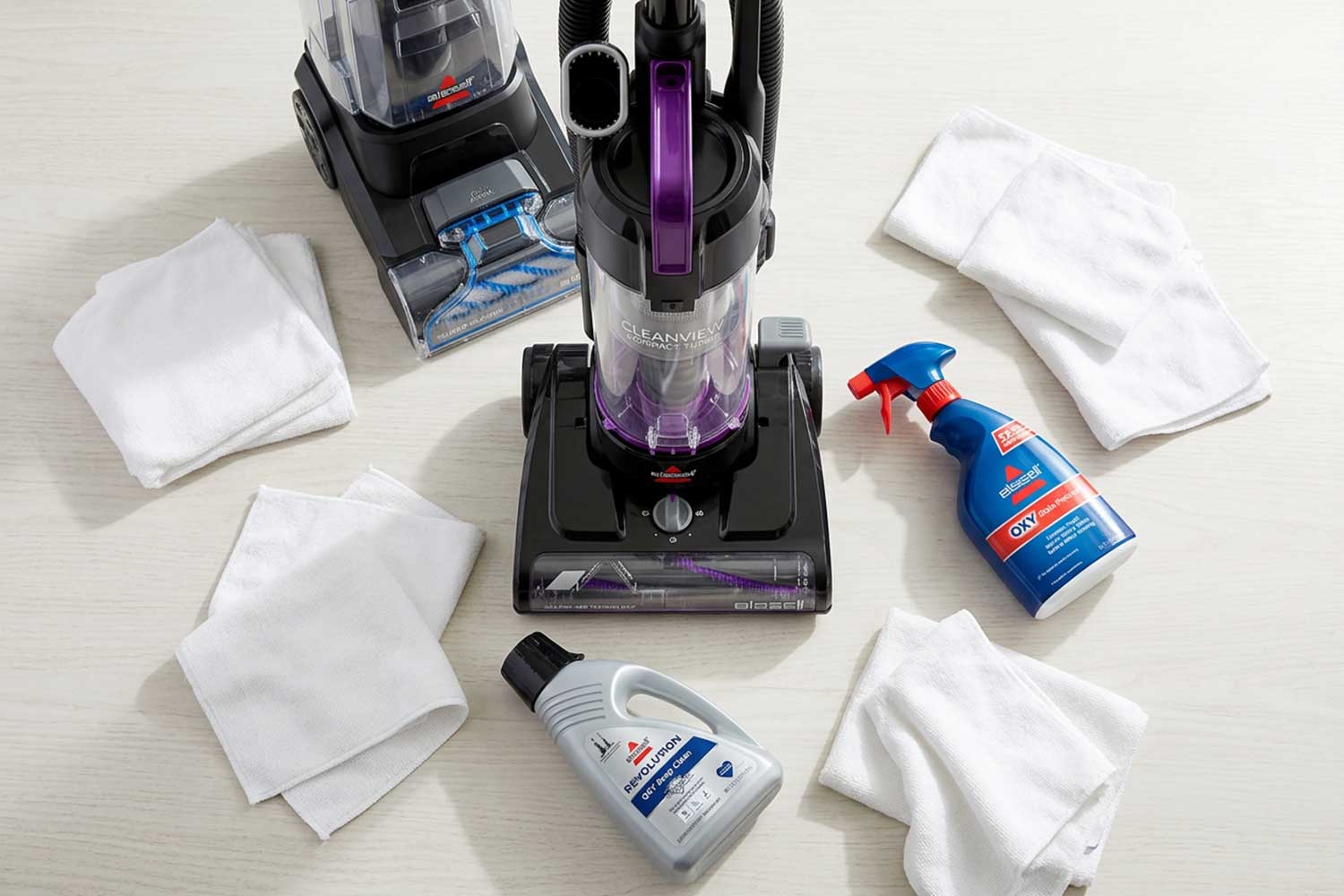
- CleanView® Compact Turbo Upright Vacuum – removes loose grass and soil before wet cleaning
- OXY Stain Pretreat for Carpet & Upholstery – pre-treat spray; allow to dwell before machine cleaning
- TurboClean™ Pet Upright Carpet Cleaner – deep cleaning with 4-Row DeepReach PowerBrush® and powerful suction
- Revolution™ Formula with OXY for Upright Carpet Cleaners – machine formula; removes embedded dirt and stains, eliminates odors, protects against future stains with StainProtect® Technology
- Clean white cloths or paper towels
- A dull knife or stiff brush (for loosening dried grass before vacuuming)
Before you start
Vacuum the stained area thoroughly before introducing any moisture – this is more important for grass stains than most other carpet stains. Loose grass blades, soil, and dry debris wet into the pile and become significantly harder to remove once damp from the cleaning process. Use the CleanView® Compact Turbo upright vacuum to lift as much loose material as possible first. For dried or crusty grass, gently loosen surface debris with a dull knife or stiff brush before vacuuming.
How to get grass stains out of carpet: step-by-step
[IMAGE SUGGESTION OF TurboClean™ Pet upright carpet cleaner cleaning grass stain]
For area rugs, check the manufacturer's tag and spot-test in a hidden area before cleaning. Do not use on silk or delicate rugs. <H3> Step 1: Vacuum loose grass and soil
Before any wet treatment, vacuum the stained area thoroughly with the CleanView® Compact Turbo upright vacuum. For dried grass that has hardened in the pile, gently loosen with a dull knife first, then vacuum. Remove as much dry material as possible – the more you remove now, the more effectively the pre-treat and machine cleaning can address the stain itself.
Step 2: Pre-treat with OXY Stain Pretreat for Carpet & Upholstery
Spray OXY Stain Pretreat for Carpet & Upholstery directly onto the stained area, covering the full extent of the grass stain. Allow it to dwell for at least 3 minutes – the OXY chemistry needs time to begin breaking down the chlorophyll pigment bonds and tannin compounds before machine cleaning begins. For a dried or set-in stain, allow the full 5 minutes.
Pro tip: Grass stains often extend further than they appear – soil and chlorophyll can spread beyond the visible green area underneath the pile. Apply the pre-treat spray slightly beyond the visible stain boundary to capture the full extent of the discoloration.
Step 3: Fill the TurboClean™ Pet upright carpet cleaner
Pull out the TurboClean™ Pet Upright Carpet Cleaner, lift the Clean Water Tank up to remove from the machine and unscrew the yellow cap. Fill with warm tap water to the water line, then add Revolution™ Formula with OXY for upright carpet cleaners to the formula fill line. Screw the cap back on securely and push the tank down until it is seated firmly on the base.
Step 4: Make cleaning passes
Plug in, press the power switch to turn on, and step on the recline pedal. Make 4 cleaning passes over the stained area: Move forward with the trigger pressed, then backward with the trigger released. Move forward again with the trigger pressed, then slowly backward with the trigger released .
Continue making dry passes – trigger released – until the solution being pulled up appears clean and there is a noticeable reduction in the amount of liquid being extracted. For Berber-style carpet, avoid repeated strokes in the same area to prevent damage to the loop pile.
Step 5: Repeat as needed
Chlorophyll and tannin pigments are persistent – grass stains, particularly dried ones, typically require more than one cleaning pass. Re-apply OXY Stain Pretreat for Carpet & Upholstery, allow to dwell, and repeat the cleaning passes. Continue until no green color remains visible in the pile.
Step 6: Dry and assess
Allow the carpet to dry fully before assessing – grass stain pigment can look different wet versus dry. Good ventilation speeds drying. Once dry, vacuum the area to restore the pile. If any green discoloration remains, repeat the full process.
Grass stains on upholstery
For grass stains on upholstery – outdoor cushions, a sofa near a back door, car seats – the same pre-treat and OXY formula approach applies. Check the care tag first: Furniture cushions or car upholstery that show a W or WS on the care label can be treated at home with water-based solution. Care tags that only show an S or Dry Clean Only requires a professional. X should only be vacuumed. Do not use on velvet or silk. Always test in an inconspicuous spot first.
Use the TurboClean™ Pet Upright Carpet Cleaner's 7-foot hose and 4" Self-Cleanout Tool for targeted upholstery treatment – the same pre-treat and OXY formula combination works through the hose attachment. Alternatively, any BISSELL® portable deep cleaner paired with an OXY formula gives you a strong foundation for treating grass stains on upholstery. Apply less solution on upholstery than carpet and extract thoroughly with slow passes to avoid over-wetting.
Why DIY solutions fall short on grass stains
The most commonly recommended DIY approaches for grass stains are dish soap, white vinegar, rubbing alcohol, and baking soda. Each addresses part of the problem.
Dish soap has surfactant action that helps lift soil and some residue, but no OXY chemistry to break down chlorophyll or tannin pigment bonds. Left in carpet fiber, soap residue becomes sticky and attracts more soil which can cause a buildup of dirt and dust.
White vinegar is a mild acid that can affect some surface pigment but lacks the penetrating chemistry needed for chlorophyll – and at full strength, can weaken carpet fiber over time.
Rubbing alcohol has limited solvent action but doesn't extract anything from the pile, simply redistributing pigment within the fiber.
Baking soda absorbs some surface moisture when applied to a very fresh spill but has no pigment-breaking chemistry, and powder left in carpet fiber is its own cleanup problem.
Hydrogen peroxide has oxidizing action – it's a key ingredient in BISSELL® OXY formulas – but applied on its own lacks the surfactants and wetting agents that allow it to penetrate fiber and lift the stain effectively. On colored or patterned carpet, undiluted hydrogen peroxide also carries a real bleaching risk.
OXY chemistry delivered by a pre-treat spray and a machine that extracts the loosened pigment from the pile is what fully removes grass stains from carpet.
Carpet and rug type considerations
- Synthetic carpet (nylon, polyester) responds well to the full process including multiple cleaning passes.
- Wool and natural-fiber carpet absorbs chlorophyll and tannin pigment readily – act quickly, use less solution, and allow extra drying time; consult a professional for set-in grass stains on wool.
- Berber and loop-pile carpet – make sure you avoid repeated strokes in the same area per the machine's user guide; let the pre-treat chemistry do more of the work before extracting.
- Area rugs – check the manufacturer's tag and test for colorfastness before cleaning; do not use on silk or delicate rugs.
FAQs
Do grass stains come out of carpet?
Yes – with the right chemistry and prompt treatment. Fresh grass stains that are vacuumed up first, then treated with OXY Stain Pretreat for Carpet & Upholstery and deep cleaned with the TurboClean™ Pet upright carpet cleaner are almost always fully removable. Dried grass stains require more effort and may need multiple sessions but typically respond well to repeated OXY treatment.
How do you get dried grass stains out of carpet?
Loosen any dried surface debris with a dull knife or stiff brush, then vacuum thoroughly. Apply OXY Stain Pretreat for Carpet & Upholstery and allow the full 5-minute dwell time. Deep clean with the TurboClean™ Pet upright carpet cleaner that’s using Revolution™ Formula with OXY to address the grass stain. Repeat as needed – dried grass stains typically require multiple cleaning passes.
How do you get grass stains out of a car carpet?
The same process applies to car carpet – vacuum first, pre-treat with OXY Stain Pretreat for Carpet & Upholstery and allow to dwell, then clean with a portable deep cleaner from BISSELL® and OXY formula using the hose and tool attachment. Car carpet is typically low-pile and responds well to the process, though trunk carpet and floor mats may need more than one session for tracked-in grass and soil.
Will OXY cleaner remove grass stains?
Yes – OXY chemistry is well-suited to grass stains because it breaks down the chlorophyll and tannin compounds at a molecular level. For best results, use OXY Stain Pretreat for Carpet & Upholstery as a pre-treat spray and Revolution™ Formula with OXY for upright carpet cleaners in the machine – OXY chemistry at both stages of the cleaning process gives the best result.
How do you get grass stains out of upholstery?
Check the care tag first – W or WS upholstery can be treated at home; S or Dry Clean Only requires professional cleaning. Test in an inconspicuous spot. Once it’s safe to proceed, pre-treat with OXY Stain Pretreat for Carpet & Upholstery and clean using the TurboClean™ Pet Upright Carpet Cleaner's hose and tool attachment, or any BISSELL® portable deep cleaner with an OXY formula. Use lighter solution application on upholstery than carpet and extract thoroughly.
This is a carousel. Use the Next and Previous buttons to navigate between slides.
This is a carousel. Use the Next and Previous buttons to navigate between slides, or use the scrollbar to scroll through content.