How to Get Egg Off a Upholstery
Key takeaways
- The most common egg stains on upholstery are raw yolk – with its vivid yellow carotenoid pigment – and raw egg white, which dries to a stiff clear film similar in appearance to a milk stain.
- Warm water is fine for cleaning egg off furniture; hot water is not. Heat sets egg protein into upholstery fiber permanently – avoid it at every stage of cleaning.
- The BISSELL® Pet Stain & Odor Remover + Sanitize Pretreat kills 99.9% of bacteria1 on soft surfaces – essential for raw egg, which carries salmonella risk.
- Check the care tag on furniture and upholstery and note fabric restrictions before applying the sanitizing pre-treat – it is not suitable for polypropylene/olefin or wool fibers.
Jump to cleaning instructions
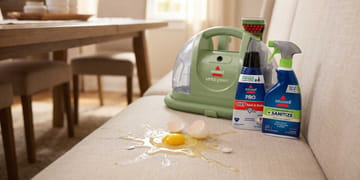
An egg rolls off the counter and splatters across the seat of a banquette. A sunny side up egg leaves a runny yellow yolk mark on a dining room chair cushion. These are the most common egg stains on upholstery – raw egg in one form or another, with a vivid yellow pigment, protein that sets quickly, and a bacterial risk that most cleaning techniques don't address.
This guide, assembled by the cleaning experts at BISSELL, covers how to fully remove egg from upholstery and sanitize the surface in one process.
Pro tip: Treat the egg spill before it dries. Raw egg protein bonds more strongly to fabric the longer it sits. A fast response can mean the difference between a quick lift and a stubborn stain.
Why egg stains are different from other food stains
Protein, fat, and bacteria – a three-part problem
Egg contains two distinct stain-forming components. Egg white is almost entirely protein – specifically albumin – that bonds to upholstery fiber on contact and becomes increasingly difficult to remove as it dries. Egg yolk adds fat alongside carotenoid pigment, the yellow color that can leave a faint discoloration on light fabric even after the bulk of the yolk is removed. Together they create a layered stain that requires both surfactant chemistry to emulsify the fat and OXY chemistry to address the pigment.
Raw eggs can carry salmonella. Spot-cleaning that lifts the egg stain without sanitizing the fabric leaves bacteria behind – which is especially a concern on upholstery your kids or pets touch. A special sanitizing cleaning formula for upholstery can help minimize the risk.
Why warm water is fine but hot water is not for cleaning eggs off a couch
Egg protein behaves like all proteins under heat: it denatures and bonds permanently to whatever surface it's in contact with. Hot water accelerates this process, setting the stain into the fiber before it can be removed. Warm water is safe and effective – it helps loosen the stain without the risk that comes with heat. Avoid hot water at every stage: this includes blotting, pre-treating, and machine cleaning.
Why sanitizing matters with raw egg
Most food stains on upholstery are an aesthetic problem. Raw egg is also a hygiene problem. Standard carpet cleaning formulas clean and deodorize but are not formulated to kill bacteria. The BISSELL® Pet Stain & Odor Remover + Sanitize Pretreat specifically kills 99.9% of bacteria1 on soft surfaces – making it the right pre-treat for any raw egg incident, not just a cleaning convenience.
Before you start: check the care tag
Find the care tag before applying any product to the fabric – it’s often hidden under the cushion, on the frame, or on the furniture skirt. Here’s how to read the cleaning instructions:
- W or WS: water-based cleaners are safe; proceed with the steps below using the Little Green® portable carpet cleaner
- S: solvent-based cleaning only; water-based products are not appropriate for this fabric; contact a professional cleaner
- Dry Clean Only or X: do not attempt home cleaning; contact a professional upholstery cleaner
Note: BISSELL® Pet Stain & Odor Remover + Sanitize Pretreat is not suitable for use on polypropylene/olefin or wool fibers. If your upholstery is made of either of these materials, skip the sanitizing pre-treat and use the OXY machine formula only – or consult a professional cleaner.
Always spot-test in a hidden area and allow to dry to note any fabric changes before moving on to clean the stain.
What you'll need
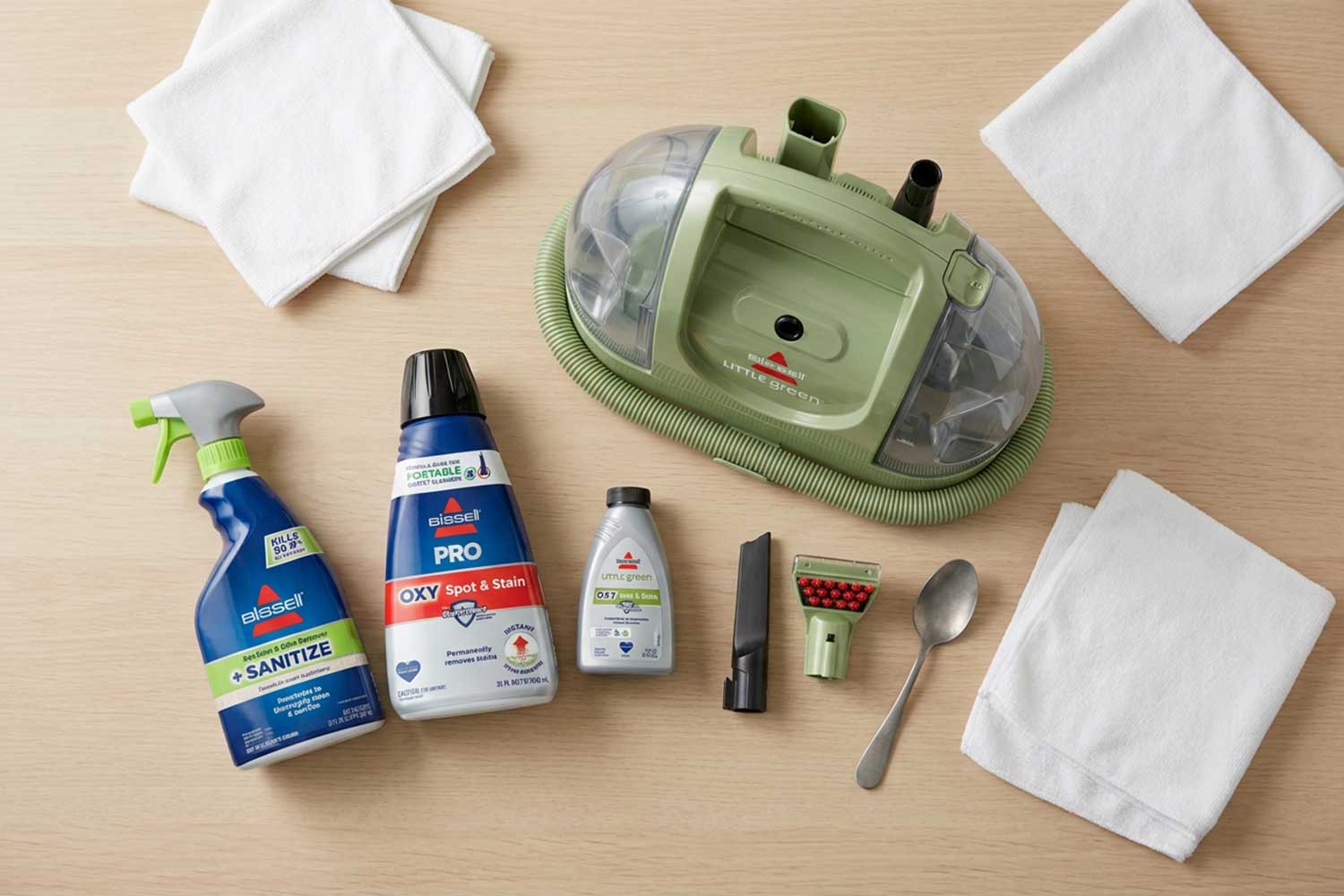
- Little Green® Portable Carpet & Upholstery Cleaner – includes 3", 4", and 6" Tools
- BISSELL® Pet Stain & Odor Remover + Sanitize Pretreat – sanitizing pre-treat spray; kills 99.9% of bacteria on soft surfaces ¹
- PRO OXY Spot & Stain with StainProtect® Technology Formula – machine formula; OXY stain removal plus StainProtect® barrier after cleaning
- A dull knife or spoon
- Clean white cloths or paper towels
How to get egg off a couch: step-by-step
Step 1: Remove excess egg – lift, don't smear
Use a dull knife or spoon to gently lift egg from the upholstery surface, working from the outside of the stain inward with shallow upward movements. Do not press down – pressing drives egg deeper into the fiber weave. For runny egg white or yolk that has spread across the fabric, blot with a clean white cloth, pressing down and lifting straight up. Replace the cloth as it saturates. Do not rub.
Pro tip: Work with white cloths. Colored cloths can transfer dye to damp fabric and compound the problem.
Step 2: Sanitize and pre-treat
Spray BISSELL® Pet Stain & Odor Remover + Sanitize Pretreat directly onto the stained area. Allow it to dwell for at least 3 minutes – this gives the formula time to both sanitize the surface and begin loosening the stain before machine cleaning.
Important: this product is not suitable for polypropylene/olefin or wool fibers. If your upholstery is made of either material, skip this step and proceed directly to machine cleaning with the PRO OXY formula.
Step 3: Set up the Little Green® portable carpet cleaner
Pull out the Little Green® portable carpet cleaner or a similar portable carpet cleaner that can address egg stains on a couch. Remove the Clean Water Tank by lifting it straight up and away from the machine. Unscrew the black cap at the bottom of the tank and add PRO OXY Spot & Stain with StainProtect® Technology Formula to the FORMULA line. Then, fill with warm tap water to the WATER line. Replace the cap, line up the vertical guides with the indentations on the tank, and slide into place until it clicks.
Release the flex hose from the hose grip bracket latch, unwind the cord, plug in, attach the 3" or 4" Tool to the hose until it clicks, and press the power button to turn on.
Step 4: Spray, scrub, and extract
Hold the tool approximately 1 inch above the stained area and press and hold the trigger to spray solution onto the stain. Release the trigger and use the bristles to gently scrub the area. Then press the tool firmly against the surface and pull slowly toward you with the trigger released slowly to extract the solution and loosened stain. Repeat as needed until the area looks clean.
Pro tip: Work in small sections on upholstery – apply, scrub gently, extract, assess – then move to the next section. This keeps moisture controlled and prevents the stain spreading.
Step 5: Repeat as needed
Egg stains – particularly dried egg yolk with its carotenoid pigment – may not fully lift on the first cleaning attempt. Re-apply the BISSELL® Pet Stain & Odor Remover + Sanitize Pretreat, allow to dwell, and repeat the machine cleaning pass. The PRO OXY Spot & Stain formula also deposits a StainProtect® barrier on the fiber after cleaning, making the surface more resistant to future staining.
Step 6: Dry and assess
Allow the area to air dry fully with good ventilation before assessing. Open windows or run a fan across the surface. Keep the furniture out of use until completely dry. If any stain or odor remains after drying, repeat the entire process.
Egg stain variations on upholstery
Raw egg splatter
The full combination – yolk, white, and bacteria together. An egg that rolls off a counter and breaks open on a banquette seat or nearby chair is the most demanding scenario: vivid yellow pigment from the yolk, protein from the white, fat from the yolk, and the full bacterial risk of raw egg. Act immediately, use the sanitizing pre-treat at full dwell time, and treat the stain area.
Runny egg yolk only
A broken sunny side up egg at breakfast is the most common single-component egg stain. Raw yolk is still liquid and carries carotenoid pigment – the vivid yellow-orange color that can leave a noticeable mark on light upholstery. It also carries fat and bacteria. Blot excess yolk immediately without spreading, pre-treat with the sanitizing spray, and expect the OXY formula to do most of the work on the pigment.
Egg white only
Egg white is clear to slightly cloudy when wet and dries to a stiff, clear film in the fiber – in appearance more like a milk stain than a colored food stain. It's easy to miss until it has dried and the fabric feels stiff in the affected area. Egg whites are pure protein with no pigment, but they’re still raw and need to be sanitized. Warm water softens dried egg white before pre-treating; avoid any application with high heat throughout the cleaning process.
Cooked egg and scrambled egg
Scrambled eggs and other cooked preparations are primarily a grease stain – the fat from cooking oil or butter – rather than a raw egg stain. The protein has already been set by heat during cooking and bacterial risk is significantly lower. For scrambled egg or cooked egg residue on upholstery, see our guide to [how to get grease out of upholstery] for the appropriate cleaning approach.
Why DIY solutions fall short on egg stains
The most commonly recommended DIY approaches for egg on upholstery are dish soap with warm water, white vinegar, baking soda, and hydrogen peroxide. Each address only part of the problem, according the BISSELL chemists.
Dish soap has surfactant action that helps with the fat component of egg yolk but no chemistry to break down the protein bonds holding egg white to fiber, and no sanitizing capability for raw egg. Left in upholstery, soap residue becomes sticky which can add to your cleaning problems. White vinegar is a mild acid with no surfactant or protein-breaking chemistry – it won't lift egg protein from fiber. Baking soda can absorb some surface moisture when applied to a very fresh spill but has no ability to break down protein, fat, or pigment, and powder left in upholstery fiber creates a separate cleanup challenge.
Hydrogen peroxide's oxidizing action makes it a key ingredient in BISSELL® OXY formulas, but straight from the bottle it lacks the surfactants and wetting agents needed to penetrate the fibers and fully suspend the stain for extraction. On colored upholstery, undiluted hydrogen peroxide also carries a bleaching risk.
Even more importantly, none of these approaches sanitize. A surface that looks clean after a DIY treatment may still harbor bacteria from raw egg – the only solution is a formula specifically designed to kill bacteria on soft surfaces.
Upholstery fabric considerations
- Microfiber and synthetic upholstery respond well to the full process including the sanitizing pre-treat
- Cotton and linen absorb egg protein readily – act quickly and use less solution to avoid over-wetting
- Velvet, silk, and chenille are delicate – use minimal solution if called for by the manufacturer’s instructions, avoid scrubbing, and consult a professional for dried or large egg stains on these fabrics
- Polypropylene/olefin and wool cannot be treated with the BISSELL® Pet Stain & Odor Remover + Sanitize Pretreat – proceed with machine cleaning using the PRO OXY formula only, or consult a professional
FAQs
Does egg permanently stain upholstery?
Not usually, with prompt treatment. Fresh egg on W or WS upholstery is almost always treatable at home with the BISSELL® Pet Stain & Odor Remover + Sanitize Pretreat and Little Green® portable carpet cleaner with a BISSELL® OXY formula. Dried egg yolk may leave a faint yellow shadow on very light fabric after thorough cleaning. Repeating the cleaning steps with the stain-lifting power of OXY solutions can help remove all traces of egg stains.
How do you get dried egg off a couch?
Gently scrape off any dried surface residue with a dull knife. Dampen the area lightly with warm water to rehydrate the stain before applying BISSELL® Pet Stain & Odor Remover + Sanitize Pretreat at the full dwell time. Clean with the Little Green® portable carpet cleaner and expect multiple passes for dried stains.
Is raw egg on upholstery a health risk?
Yes – raw egg can carry salmonella bacteria. A cleaning approach that removes the visible stain but doesn't sanitize the fabric leaves bacterial contamination behind. The BISSELL® Pet Stain & Odor Remover + Sanitize Pretreat kills 99.9% of bacteria1 on soft surfaces when used as directed – use it as the first step on any raw egg incident. Note that it is not suitable for polypropylene/olefin or wool fibers.
Why does my couch still smell like egg after cleaning?
Persistent egg odor after cleaning usually means protein residue wasn't fully extracted from the fiber – the bacterial breakdown of protein is what produces the smell. Begin by using BISSELL® Pet Stain & Odor Remover + Sanitize Pretreat at full dwell and then make another full cleaning pass with your machine. Ensure the area dries completely – residual dampness can intensify odor.
Can I use warm water to clean egg off a couch?
Yes – warm water is appropriate for cleaning egg from upholstery. The restriction is on hot water, which sets egg protein into fiber permanently. Warm water loosens and helps remove egg protein without the risk that comes with heat. Use warm water at every stage: blotting, pre-treating, and machine cleaning.
How do you get egg yolk out of upholstery?
Lift any excess yolk with a dull knife, then apply BISSELL® Pet Stain & Odor Remover + Sanitize Pretreat and allow to dwell for at least 3 minutes. Clean with the Little Green® portable carpet cleaner using PRO OXY Spot & Stain with StainProtect® Technology Formula making slow passes with a portable carpet cleaning machine. The carotenoid pigment in egg yolk may require multiple cleaning passes to fully lift on light-colored upholstery.
Kills 99.9% of Enterobacter aerogenes (ATCC 13408) and Staphylococcus aureus (ATCC 6538)(Staph) on carpets and soft surfaces. Not for use on polypropylene/olefin or wool fibers.
This is a carousel. Use the Next and Previous buttons to navigate between slides.
This is a carousel. Use the Next and Previous buttons to navigate between slides, or use the scrollbar to scroll through content.